The Insurance Math Royal Palm Buyers Are Missing in 2026
September 3, 2026
September 3, 2026
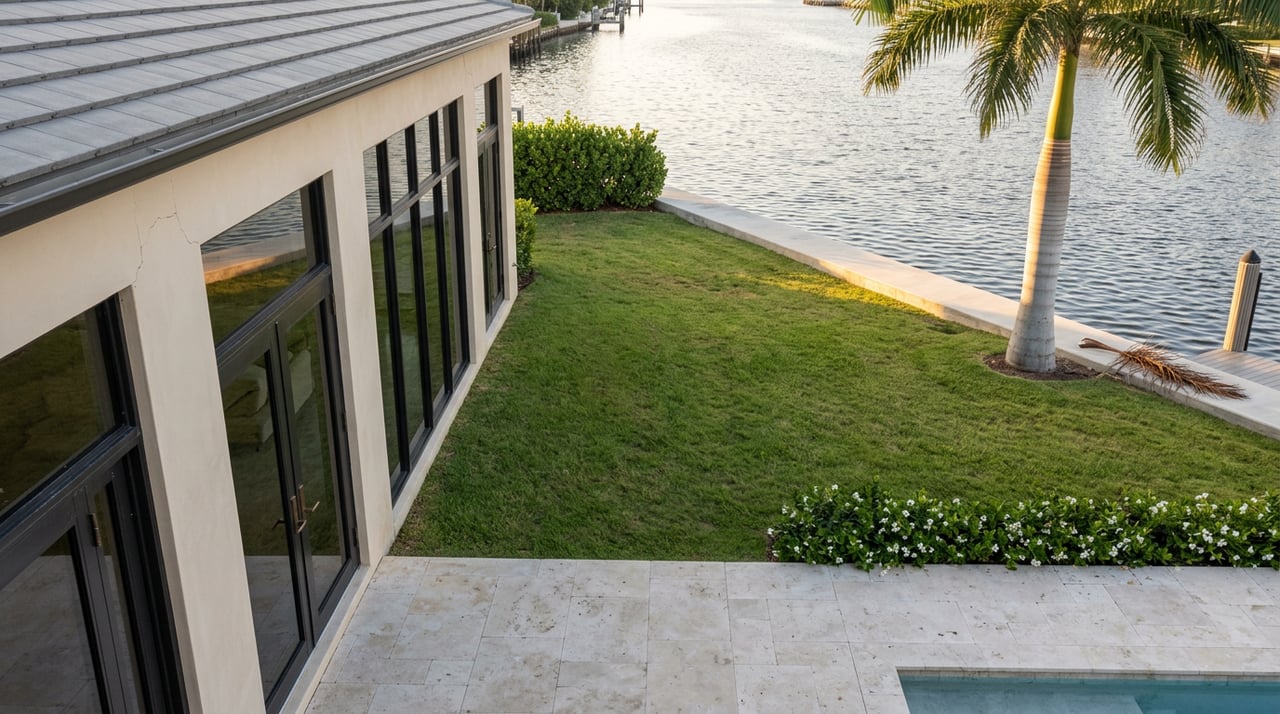
A 9,100-square-foot estate on West Coconut Palm Road closed in late August 2026 for $16.9 million, about 11 percent under its original ask. Anyone tracking Royal Palm Yacht & Country Club noticed the discount. Almost nobody asked about the insurance renewal that came with it.
That is the gap this post is built to close. Buyers comparing a deep-water lot to a golf-course lot to an interior parcel inside Royal Palm tend to do the math on price per square foot, HOA dues, and club fees. Those numbers are stable and public. The line that actually moves, and moved harder in 2026 than it has in over a decade, is homeowners insurance. And it did not move the same amount for every kind of lot in this community.
Royal Palm's fixed costs are unusually easy to state. According to Royal Palm Yacht & Country Club, the community HOA is $4,150 per lot, paid annually every July 1, and there has never been a special assessment against it. Club membership, unlike at St Andrews, Broken Sound, or Woodfield, is optional rather than mandatory, so a buyer who skips the $210,000 initiation fee and the $18,000 to $30,000 in annual dues those clubs require simply never sees that cost. Pricing runs high across the board, with recent estimates putting the community average around $2,235 per square foot against a citywide Boca Raton luxury single-family average of about $648.
None of that changes lot to lot inside the gates. A $2 million interior home and a $20 million deep-water estate both pay the same HOA. What does not hold steady is the insurance premium, and 2026 is the first year in a long time where that premium is moving in a buyer's favor, unevenly, and for reasons worth understanding before you write an offer.
Palm Beach County already carries the second-highest average homeowners premium in the state, $6,412 a year, trailing only Monroe County's barrier islands in the Keys. That backdrop is what makes 2026's relief worth reading carefully rather than skimming.
From 2021 to 2024, the statewide average homeowners premium in Florida climbed from roughly $2,520 to $4,480, a 78 percent increase in three years, as carrier insolvencies pushed hundreds of thousands of policies onto Citizens Property Insurance Corporation, the state's insurer of last resort. That run ended in 2026. Citizens approved its first broad rate decrease since 2015, and the Florida Office of Insurance Regulation reported decreases across 51 of the state's 67 counties.
Governor Ron DeSantis's office framed the shift plainly in its 2026 announcement:
The reductions in Citizens Insurance rates are the most significant in recent memory. Premiums are lowering because we've enacted real reforms and withstood the pressure to reverse course.
The same announcement broke the relief down by county. Palm Beach homeowners on Citizens policies, roughly 26,000 of them, are seeing an average reduction of 11.9 percent starting at spring 2026 renewals. That is smaller than the 14.1 percent Broward posted or the 14.0 percent in Miami-Dade, but it is still well above the 8.7 percent statewide average and one of the larger county-level corrections in Florida. Palm Beach's premiums, like those of its tricounty neighbors, had carried a disproportionate share of pre-reform litigated claims that inflated costs beyond what actual storm losses justified. Citizens' own policy count tells the same story from a different angle, falling from about 1.42 million in October 2023 to roughly 395,000 by January 2026 as private carriers re-entered the market and started taking policies back out of the state pool.
Here is the detail that matters more than the headline percentage. Citizens caps standard dwelling coverage at $700,000. A large share of Royal Palm's housing stock, priced from $2 million to $30 million and up, was never eligible for a Citizens policy in the first place. Those homes have always been insured through private carriers or surplus lines markets, which means the 11.9 percent figure making headlines describes a book of business that does not include most Royal Palm estates.
That does not mean the relief is irrelevant to this community. It means the relief shows up differently. Private carriers are competing for business again for the same underlying reasons Citizens is cutting rates: less litigation, more reinsurance capacity, more competitors in the market. State Farm filed a 10 percent rate decrease. Florida Peninsula filed 8.2 percent. Security First filed 8 percent. Those cuts apply to policies well above the Citizens dwelling cap, which is where most Royal Palm coverage actually sits. The county-level Citizens number is a useful directional signal that the market has turned. It is not the number that will appear on a $10 million estate's renewal notice, and a buyer who assumes otherwise is comparing the wrong figure.
This is also where lot type inside Royal Palm starts to matter in a way price per square foot does not capture. A deep-water lot with 100-foot-plus yacht dockage carries the highest rebuild value in the community and sits directly exposed to storm surge and wind, which historically pushed those premiums to the top of the private and surplus-lines market, often the segment hit hardest by the pre-reform litigation surcharge. An interior lot, by contrast, typically carries lower rebuild cost and less direct surge exposure, and its premium has likely tracked closer to the broader softening carriers have filed across the board. The golf-course lot sits between the two, sharing the wind exposure of the neighborhood without the surge risk of the waterfront.
The result is that the insurance line, which used to be the cost buyers accepted without much comparison shopping, is now the variable most worth pricing out lot by lot before making an offer, because the relief carriers are filing in 2026 is landing unevenly across exactly those three categories.
| Lot type | Primary exposure | What moved in 2026 |
|---|---|---|
| Deep-water, private dockage | Storm surge, direct wind, highest rebuild value | Largest dollar relief as private and surplus carriers re-price after tort reform, but starting premium was also highest |
| Golf course | Wind exposure without surge, mid-tier rebuild value | Tracks the general market softening |
| Interior | Lowest direct storm exposure | Smallest absolute change, since premiums were never as inflated to begin with |
None of this shows up in a listing sheet. It shows up in the quote a buyer gets after going under contract, which is exactly why it belongs in the conversation before an offer rather than after.
Rate decreases do not apply automatically. They take effect at policy renewal, and Property Exemption reports that insurers are required to send renewal notices at least 45 days ahead of that date. A buyer closing on a Royal Palm estate this fall inherits whatever policy is in force at closing, not a future renewal discount, unless the deal is structured around it. That is a detail worth raising directly with a carrier or an independent agent before closing, not after.
Wind mitigation inspections remain one of the more reliable levers a buyer or owner has, since Atesa Risk Advisors says carriers can credit 20 to 45 percent off the wind portion of a premium for verified roof age, opening protection, and construction features. For a waterfront estate where wind is the largest variable cost, that inspection is worth ordering before the policy is bound, not after the first renewal notice arrives.
If you are weighing a waterfront estate against a golf-course home inside Royal Palm, or wondering how permit and dock considerations factor into that same waterfront premium, our guide to dock, seawall, and lift permits for Royal Palm homes and our earlier breakdown of choosing between waterfront and fairway lots cover the pieces of this decision that sit outside the insurance line.
Does the 11.9 percent Palm Beach cut apply to a $10 million estate? Not directly. That figure describes Citizens Property Insurance policies, which are capped at $700,000 in dwelling coverage. Most Royal Palm estates are insured through private or surplus lines carriers, several of which filed their own separate rate decreases in 2026, generally in the 5 to 10 percent range.
Why is Palm Beach's cut smaller than Broward's or Miami-Dade's? All three tricounty markets carried the same kind of pre-reform litigation-driven inflation, but each carrier's 2026 rate filing is based on that specific county's claims and litigation history rather than a single statewide number. Palm Beach's 11.9 percent reduction still reflects the same tort-reform-driven correction, just calculated against its own local caseload.
Can the Royal Palm HOA ever levy a special assessment? According to the community's own published terms, dues are fixed and there has never been an assessment. That stability is part of why insurance, not HOA dues, is the cost line that actually differentiates one lot from another here.
Comparing a waterfront estate to a golf-course home inside Royal Palm is rarely just a price-per-square-foot exercise once the insurance line is priced out correctly. If you want that comparison run against a specific address, reach out to Portia Voss and start with a home valuation before you make an offer.
This article is general information, not legal, tax or financial advice. Consult a qualified professional about your situation.
Stay up to date on the latest real estate trends.


Whether you're buying, selling, relocating, or evaluating a real estate opportunity, receive experienced guidance and personalized representation from consultation through closing.